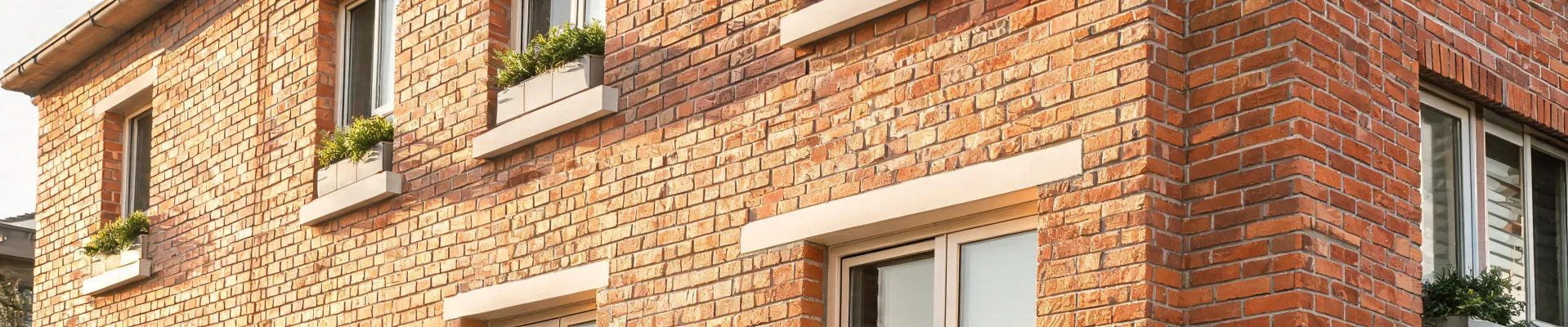
The lowest quote on masonry brick, commercial tile, or timber framing is usually the most expensive option you'll get — once you count the rework, the schedule delays, and the phone calls to a supplier who's suddenly stopped returning messages.
I'm the quality/compliance manager at acme-brick. I review about 200 unique product batches a year across our distribution network. In 2024, I rejected just under 9% of first deliveries. Not because I'm excessively picky — because the delivered product didn't match the specification on the paperwork. Dimensional tolerances exceeded. Moisture content outside the stated range. Tile dye lots that didn't align. Every rejection cost the buyer money they hadn't planned to spend.
This isn't an argument to always buy the premium option. I've seen premium-priced material fail on the job site. The point is simpler: price per unit is a poor way to compare suppliers. Total cost — spec compliance, consistency, failure risk, and your own time — is the only number worth comparing.
That's the short version. The rest is the evidence.
Why I'm qualified to say this
I've been in this role for four years. Before that, I worked on the contractor side, so I've seen both ends of the problem. When I joined acme-brick in early 2022, the first thing I did was implement a verification protocol for incoming batches. Every supplier shipment gets sampled, measured, photographed, and compared against the published spec sheet before we sell it.
The number I keep going back to is from Q1 2024. We received a lot of 12,000 modular bricks where the specified dimensional tolerance was ±1/8 inch per ASTM C216. The bed depth was running 3/16 inch over. On a pallet, you couldn't see the problem. Lay them with standard 3/8-inch mortar joints and each course runs close to 3/16 inch tall. After ten courses, that's nearly 2 inches of accumulated deviation. Wall heights, window lintels, door openings — all of it off. The contractor would've caught it partway up the first elevation, after the footing and layout were already done.
We rejected the lot. The vendor remanufactured it at their cost, and the project lost roughly three weeks. The buyer had saved maybe $0.06 per brick. I don't know the exact number. What I know is the delay cost more than the total order value. That's what I mean by hidden costs. They never show up on the purchase order. They show up on the change order.
Where "cheap" quietly gets expensive
Masonry brick: spec compliance is the hidden tax
When buyers ask me about masonry brick specifications, most people want to talk about compressive strength. It matters for structural applications. Fine. But in my experience, the spec that causes the most job site problems is dimensional tolerance within a single lot.
A brick that's uniformly 1/16 inch over is manageable. A brick that varies by 1/16 inch in either direction across the pallets is a mess. It's not the individual unit. It's the cumulative effect. Bed joints, head joints, coursing, level lines — they all stack up. ASTM C216 covers facing brick and includes dimensional tolerance, water absorption, and efflorescence potential. The last one rarely gets attention until a new commercial wall shows white powdery stains after the first rain. It's cosmetic, not structural. But tell that to an owner who's refusing to sign off.
When we verify bricks against the spec in receiving, we're not being bureaucratic. We're catching problems that are impossible to see on a pallet but show up immediately on the wall. We do not approve any batch until the measurements are on record.
Commercial tile: consistency is the product
For commercial tile suppliers, the thing I watch most closely is dye lot consistency. You can buy a perfectly good tile at a competitive price and still get a color mismatch between production runs. Not a dramatic mismatch, either — the kind of shade shift you won't notice comparing two samples side by side, but becomes obvious across a 2,000-square-foot floor.
We photograph every delivery that comes through our receiving area. Those photos do double duty: they're part of our QC process, and they become the acme brick tile & stone photos you see on our site — real product, real lots, not manufacturer stock images. When we compare incoming tile against previous lots, we catch shade drift that the eye would miss in isolation. In late 2023, a tile shipment arrived where the lot numbers on the boxes matched, but our photo comparison showed a visible gray undertone shift across the pallets. We quarantined the batch, sent the photos to the manufacturer, and they acknowledged a kiln variation on their end and replaced it.
That's a failure that never appears in a price quote. I now advise anyone sourcing for a project to ask a prospective commercial tile supplier three questions before ordering: how do you handle lot variation, can you provide references for large commercial projects using this exact product, and what's your process if the dye lot arrives off?
Timber framing for wholesale: grade vs. moisture content
"How to choose timber framing for wholesale" is a question I get from buyers who are used to brick and block and are now adding engineered wood or LVL to their product line. The biggest misunderstanding: treating the grade stamp as if it tells you everything. A Select Structural designation describes visual and strength characteristics. It says very little about moisture content at delivery — and moisture content is what causes the expensive phone calls.
We've received premium-grade engineered lumber with moisture content above 19% that looked perfect on arrival. Two weeks later, in a conditioned space, some pieces had crowned more than 3/4 inch. The floor system built from it developed nail pops and squeaks in a project that was supposed to be premium.
Here's the counterintuitive part: I'd rather buy a lower visual grade of timber at the correct moisture content than a higher grade at the wrong one. Grade affects appearance and structural capacity. Moisture content affects whether the material keeps its geometry after installation. For wholesale buyers, predictability is what you're selling to your customers. If you can't predict how the material will behave, the grade stamp doesn't save you.
Expensive isn't automatically better
Now the part that surprises people, especially coming from someone in quality: buying the most expensive option doesn't protect you either.
In late 2024, I was comparing two glue-laminated timber suppliers for a project our sales team was quoting. All the data said use the premium brand. Cleaner spec sheets, complete certification files, and they had the price premium to match. My gut said something was off. Every time I asked for supporting test data, it took them four days to respond, and the documents came back noticeably disorganized.
I went with the mid-market supplier against my own analysis. When the samples arrived, the mid-market material had better end-joint consistency than the premium brand's own samples. I've never fully understood why that happens. My best guess is that a strong brand reputation creates a kind of complacency loop — the manufacturer stops doubting itself because nobody else is doing the checking. If you have a better explanation, I'd love to hear it.
The honest takeaway from that experience: price is a signal, not a guarantee. You have to verify in both directions. Whether you're buying on the low end or the high end, you're trusting someone's QC process. Ask suppliers what it looks like. Ask for test data. Ask what happens when a batch fails. The suppliers who answer quickly and clearly are usually the ones who don't have much to hide.
When the cheapest option actually makes sense
Let me push back on my own argument for a minute, because "never buy cheap" is just as lazy as "always buy cheap."
The budget option can be genuinely fine in a few situations. Small projects. Non-structural applications. Materials you can visually inspect on arrival for the problems that would actually matter. A backsplash in a coffee shop, a small retaining wall, a residential shed — these don't need the full verification protocol. I've told customers at Acme Brick this many times. Sometimes the budget option is the right call, and we'll help you find it.
The problem is when you apply that logic to large commercial work, structural applications, or materials that have to perform across long spans. That's where the lowest quote becomes the most expensive lesson. It's also the difference between a supplier and a partner. A supplier sends a quote. A partner tells you when the spec you ordered is probably overkill — and also tells you when the discount material will cost you more than the savings.
That's the standard I try to hold at acme-brick. We'd rather reject a batch in receiving than have it fail on your site. When I started that protocol in 2022, our first-delivery rejection rate was 14%. In 2024, it's just under 9%. That improvement didn't come from us going easier. It came from suppliers realizing that we check, and that they're better off fixing the issue before shipping.
I've noticed something else in those four years. The suppliers who complain the loudest about quality verification are usually the ones with the most inconsistent product. The strong ones have their own internal QC, and they don't mind the scrutiny. It's not a perfect test — but as heuristics go, it's held up pretty well.
If you're a residential buyer picking up a single pallet of brick, most of this won't apply to you the same way. At least, that's been my experience from this seat. If you're a commercial contractor, a distributor, or an OEM buyer comparing wholesale options, then the numbers are clear: verify the spec, verify the lot, and calculate cost from the job site back — not from the invoice forward.