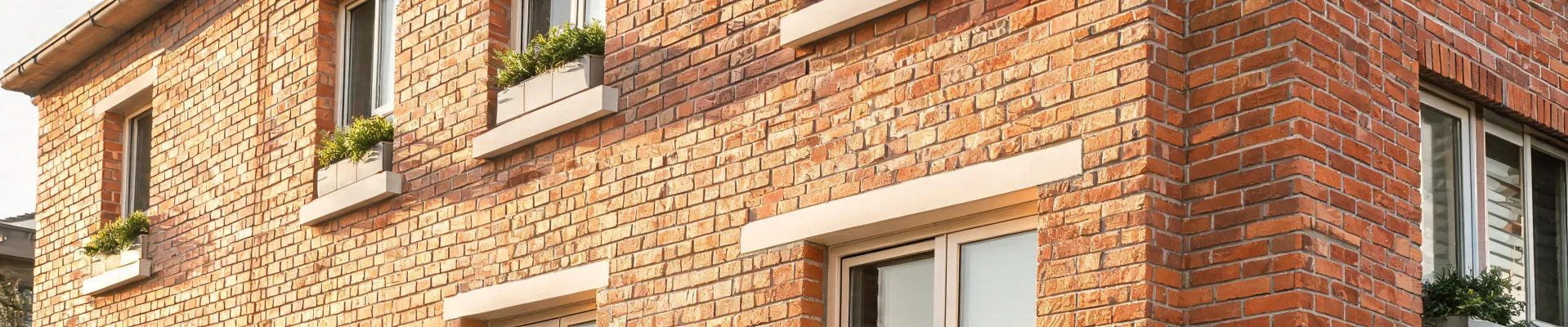
I'm a quality and brand compliance manager at a building materials distributor. I review every inbound batch before it clears for customers—roughly 220 SKUs a year across brick, block, tile, and precast. In 2023 I rejected about 18% of first deliveries for spec mismatches that should've been caught at the plant, not in our yard.
These are the questions buyers actually send me. Short answers only, no brochures.
How do you evaluate a concrete block manufacturer before you commit to a bulk order?
Paperwork first, yard second. A plant worth a purchase order can produce 90 days of compressive strength reports citing ASTM C90 (the standard specification for loadbearing concrete masonry units) tested under ASTM C140 methods. Ask for the full 90 days, not the highlight reel. Then walk the yard yourself. Look at the aggregate stockpile—if the coarse aggregate varies visibly from pile to pile, block density will too. Check pallet cube dimensions with a tape, not the submittal sheet. I've measured cubes that ran 3/8" over on the long axis (which, honestly, shouldn't happen if molds are being gauged on schedule). And ask which plant is actually producing your run. Multi-plant manufacturers quote from corporate but ship from whoever has capacity that week. Not a scandal—just something to know before the first truck shows up with a slightly different color.
What separates a real factory audit from a sales tour?
A sales tour shows you the newest line and the cleanest aisle. A real audit asks three questions: who signs off on batching, how often they sign, and what happens when a cube fails. The batch we rejected in Q3 2022 changed how I think about curing documentation—the plant's steam-cure log had been backfilled for two weeks and nobody noticed because the paperwork looked clean. Now I ask for time-stamped cure logs and cross-check them against pallet release dates. It's a five-minute check that catches a lot.
Two of those three questions you can verify on-site in an afternoon. The third—what happens when a cube fails—you verify by asking for the last failure report. Every plant has one. Plants that won't show it are telling you something.
How do you vet a mosaic tile supplier for a private label run?
Start with ANSI A137.1 for ceramic tile and pull the specific test data—water absorption per ASTM C373, DCOF per ANSI A326.3 (0.42 minimum for level interior wet areas), and PEI abrasion class. For imports, country-of-origin labeling is an FTC matter, not a nicety. I went back and forth between a domestic supplier and an import for two weeks on a 40,000 sq ft run. The import quoted 22% less. But the domestic supplier held shade consistency across three production batches when I sampled; the import couldn't. Shade variance on a mosaic is the thing that comes back. So we paid the 22%.
What belongs in a mosaic tile private label agreement that buyers always miss?
Three things. A reserved production window with a defined shade range, so you're not getting leftover lots from someone else's run. A packaging liability clause—who pays if the private label print is wrong or arrives mismatched. And an escalation clause for out-of-tolerance shipments, not just a rejection right. Rejection without a remedy timeline means your project slips while everyone waits on lawyers. I've watched a private label program sit dead for six weeks because the contract said 'buyer may reject' and then stopped.
One more: define 'out of tolerance' in numbers, not adjectives. 'Significant shade variance' is not a spec. 'ΔE greater than 2 against the approved control sample' is. Get that language in writing or the dispute is going to be a matter of opinion.
Why does Acme Brick in Fort Worth keep coming up?
Because for a lot of buyers it's still the benchmark. The company's been headquartered in Fort Worth since 1891, and the multi-plant footprint matters more than the brand name—if one plant's clay runs differently, another plant can carry the order without a visible shade break. The other reason it comes up: the plants are spread across the South, so a contractor in Texas, Oklahoma, or Arkansas can usually get the same brick across a multi-phase project without a plant change mid-stream. That continuity is worth real money on a 12-month build.
That said, don't buy the logo. Buy the spec sheet. Ask which plant is producing your run and get that plant's most recent ASTM C216 test data for facing brick. The brand is a starting point, not a substitute for due diligence.
What's the biggest misconception about block and brick sourcing?
Everything I'd read about procurement said the lowest responsible bid wins. In practice, the second-lowest bid is usually the one that ships on time. The low bidder wins the job and then discovers the freight math doesn't work, or the plant is already at capacity, and suddenly your delivery date moves three weeks. I've watched it happen on everything from 8x8x16 CMU to full pallets of thin brick. So now we score bids on landed cost plus on-time history, not unit price. Took two bad quarters to learn that.
What's changed in the last four or five years?
A lot of the fundamentals haven't—ASTM C90 is still ASTM C90, mortar is still ASTM C270. But the visibility has changed. QR codes on pallets are common now, so you can pull batch and cure data on the yard instead of waiting on a PDF. ANSI A326.3 for DCOF gets enforced in more specs than it did in 2019 (so glad I pulled samples before signing that one remodel spec—the original tile wouldn't have passed). And more distributors run their own private label programs, which means buyers have real leverage on shade control they didn't have five years ago.
What was best practice in 2020 isn't wrong. It's just incomplete.